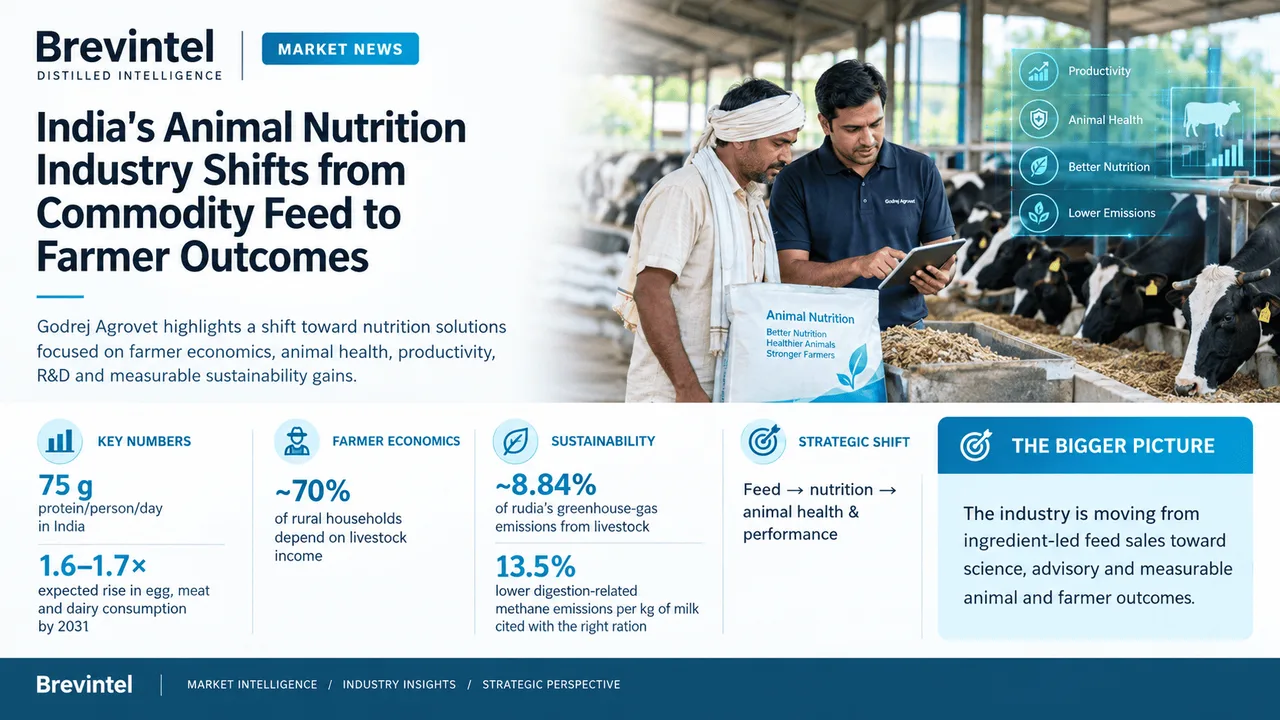
India’s animal nutrition industry is entering a period of structural change as rising protein demand, farmer economics and sustainability pressures challenge the traditional commodity-feed model. Speaking at the CLFMA AGM 2026, Sunil Kataria, CEO and Managing Director of Godrej Agrovet, outlined a shift toward nutrition solutions built around animal performance and measurable farmer outcomes.
India’s protein supply is around 75 grams per person per day, compared with 132 grams in China, while consumption of eggs, meat and dairy is expected to rise 1.6–1.7 times by 2031. This creates an opportunity for the sector, but also puts pressure on the cost and productivity of protein production.
From Feed Sales to Farmer Economics
Animal nutrition directly influences productivity, feed conversion, animal health and the eventual cost of milk, meat and eggs. With around 70 per cent of rural households depending on livestock income, the economic performance of each animal is closely connected to household income.
The industry therefore faces a broader question: whether it is selling feed or providing nutrition. An outcome-led model focuses on what farmers achieve from a product, including higher productivity, improved feed efficiency, lower mortality, stronger resilience and better returns on feed expenditure.
Commodity Exposure Creates a Need for Differentiation
Feed manufacturers remain exposed to commodity cycles through inputs such as maize and soybean meal. While raw-material costs will continue to influence the sector, companies can seek greater differentiation by linking product value to animal performance rather than feed price alone.
This shifts the commercial discussion from the cost of a kilogram of feed toward the value generated per animal. Products supported by nutrition science, farm-level insights, advisory services and demonstrated performance can potentially create greater differentiation than ingredient-based propositions.
R&D Moves Closer to Farm-Level Problems
The proposed shift also changes the role of research and development. Instead of starting with which ingredient can be added to a formulation, companies can begin with the production problem they need to solve.
Potential areas include feed conversion, milk productivity, gut health, immunity, reproductive performance, growth and environmental efficiency. Farmer-led insight can help R&D teams develop and test formulations against practical outcomes and farm economics.
Nutrition and Livestock Sustainability
Better nutrition also has implications for livestock emissions. Livestock accounts for around 8.84 per cent of India’s greenhouse-gas emissions, with enteric methane representing an important source. The source presentation noted that providing animals with the right ration can reduce digestion-related methane emissions per kilogram of milk by 13.5 per cent.
Higher productivity from better-balanced rations can therefore potentially reduce emissions intensity per unit of milk while improving farm productivity. This creates an opportunity to integrate sustainability into the core nutrition proposition rather than treating it only as a reporting objective.
Advisory Becomes Part of the Product
An advisory-led sales model could further expand the role of nutrition companies. Rather than simply recommending a feed product, companies can assess the animal, production system, ration, farm economics and performance objectives before recommending a solution.
This approach can strengthen the relationship between nutrition companies and farmers while creating a service-oriented model around nutrition decisions. Manufacturing capacity, product portfolios and operating footprints can likewise be aligned more closely with regional production systems and farmer requirements.
A Broader Animal Health and Performance Proposition
The emerging model brings feed, nutrition and animal health closer together. For farmers, feed efficiency, immunity, disease, productivity and reproduction collectively determine the economic performance of an animal rather than functioning as isolated categories.
The proposed industry blueprint connects farmer insight, nutrition science, R&D, differentiated products, advisory-led selling and measurable outcomes. Under this model, the feed bag becomes the delivery mechanism for a broader proposition focused on healthier animals, higher productivity, farmer returns, affordable protein and lower environmental impact.
For India’s animal nutrition industry, the strategic opportunity is therefore moving beyond selling more tonnes of feed toward creating more measurable value from every animal.